
Mamma Mia: Musicals Deserve Better


    Earlier this week, Variety ran a piece speculating on the future of musicals and the roles they may play in helping a post-corona theater business bounce back. After all, this year is impressively stacked with musicals. In addition to last month's fantastic "In the Heights," we've got a half dozen or so musicals slated for theatrical release. Musical master, Lin Manuel-Miranda expresses optimism about the future of musicals, declaring “[While it] hasn’t always been the case, the movie musical is now alive and well.”

    I'm always hopeful for the return of the genre, but I don't know if I share Lin's confidence that the world is ready to take musicals seriously. Not when a triumph like In the Heights plays to such a small audience. (Curse thee, "FRIENDS Reunion," for making everyone renew their HBO Max subscription two weeks before In the Heights hits theaters.) The narrative of “stop overthinking it, it’s just a musical,” is one I often hear associated with the genre, and it always breaks my heart to hear this because I just know anyone who sincerely believes this has never really experienced all that musicals can offer. Amid the world's love-hate relationship with the genre, there's one film in particular that embodies the uphill battle the genre faces. 

    Mamma Mia crashed onto the playing field in 2008. The film follows blushing bride Sophie on the eve of her wedding. Raised by her doting but hard-working mother, Donna, Sophie wants more than anything for her father to be there to give her away. The problem is ... her father could be one of three different men. To be safe, Sophie invites all three candidates, none of whom she's ever met, to the ceremony hoping to find herself before she takes this next step of life.

    Based on the 1999 stage musical, the movie was tremendously successful at the box office, grossing $650 M on a $52 M budget. This was back when musicals were a significant gamble for studios. You didn't see multiple film adaptations of beloved stages musicals in the early 2000s. The film actually didn't earn fantastic reviews, but fans of the film deflected criticism by digging into the fact that because it was a musical, it didn't have to be good. Stop overthinking it and enjoy Pierce Brosnan groaning like he's the archangel of constipation.

    There is a base of truth to this kind of deflection. There is, after all, a multiplicity of ways for a film to be "good." A film like Pan's Labyrinth is brilliant in a different way than a film like Bringing Up Baby, you need to measure either film with a different scale in order to properly assess their individual strengths. Films deserve to be judged on their own terms. 

    And it's not like Mamma Mia's chosen playing field is not capable of yielding strong results. Something like Gilmore Girls finds tremendous success and acclaim in its lane of fireplace drama best watched in your pajamas. But putting something like Gilmore Girls in the same class as Mamma Mia is like putting the finest raspberry cheesecake on the tray next to a smushed up twinkie. 
 
  The appeal of Gilmore Girls is the satisfaction of watching tremendously likable characters work out their problems in an entertaining way. Gilmore Girls is ultimately comfort food, but it is comfort food with substance. Amy Sherman-Palladino doesn't just let her characters crash into whatever and call it comedy. Though the show is defined by its pleasant tone and low-stakes drama, the writing of the show is tight, and it furthers the emotional development of these characters as they pursue happiness. The characters are not only well formed as individuals, they behave, act, and feel like human beings. Gilmore Girls respects its audience too much to ask them to dumb themselves down. There is intelligence to the show's writing. There is truth to its warmth. When you dig into what it is about Gilmore Girls that works, the flaccidity of something like Mamma Mia comes into sharp focus.

    But it's not through the lens of something like Gilmore Girls that I want to discuss Mamma Mia today. I return again to this film's place within the musical canon. Because when I hear support for this movie and its many, many holes, it is behind the shield of "musicalness" that its most ardent supporters take their stand. Because it is a musical, it is allowed to be shallow and nonsensical, and I cannot abide by this line of thinking. 

    I suppose the musical community owes this movie something for keeping the genre on life support during its last dark age. But in a world where the movie musical renaissance is within reach, this is a conversation we need to have. Fair warning, if this is the movie that got you through freshman year, I’m not here to judge, but also know that I’m not going to hold anything back with this rant. If that’s not something you’re up for, come back next month when we talk about Disney’s The Jungle Book. In the meantime, if you're going to stan Mamma Mia despite its gaping flaws, fine, but please stop throwing other musicals under the bus to do this. 

    Since escapism is one of the hot buzz words around the genre, we'll spend quite a bit of time talking about the role this plays in Mamma Mia. From there, we’ll explore how “even musicals” obey rules of storytelling (e.g. character arcs) and how Mamma Mia fails to meet that criteria. Then we’ll close out by looking at how this movie treats the mode of musical storytelling.


Musicals and Escapism Part 1: Selling the Musical

      The appeal of the musical is its ability to sweep away the viewer from their mundane or troubling circumstances with displays of earnest optimism and dazzling choreography. But in a post-9/11 world that’s a little too disenfranchised with sparkles and dancing, there’s increased pressure to acknowledge the artifice behind musical storytelling. 

    How well a musical lands has a lot to do with how seriously the audience is expected to take it. By nature, all performative art is an artifice, an illusion. But a world where emotions are spontaneously articulated through choreographed and composed musical numbers faces an especially steep climb. How do you get your audience to take the ride with you? 

        In broad strokes, there are two ways you can do this: One, you can expose the artifice of musical storytelling. Admit that the razzle-dazzle of showmanship is just plywood and paste, but use that to comment on the nature of illusion and artificiality. Two, you can reason with your audience. Tell them that the razzle-dazzle has a point, and that point can make them a better person.

    As an example of the former, let’s look at Chicago. This movie follows a spotlight-starved murderess, Roxie Hart, who finds herself under the spotlight after killing her lover. The central conceit of this movie is Roxie’s extreme narcissistic fantasies which take the form of imagined musical numbers that Roxie stages for herself within her own mind. Most of the movie’s musical numbers are not literally happening within the movie universe—they are recurring fantasy sequences as imagined by our main character. (It’s worth noting that the stage show on which this film is based simply presents the musical numbers as organic features within this universe, like most musicals.)

    This is fitting because Roxie is so attention-starved and narcissistic that she perceives her entire murder trial as one glamorous show in which she is the star. When all of that spotlight evaporates the moment the trial is over, it resonates with the movie’s larger comment on spectacle: Roxie’s time in the public arena was a whirlwind of lights and drama, but like her musical fantasies, it was also transient and illusory.

    Chicago bargains with the non-believing musical audience by finding a middle ground. It gives the audience an excuse to indulge in the glitter of musical storytelling by making the genre’s artificiality the movie’s punchline. I’ll concede that this isn't my favorite style of musical-ing, but Chicago knows what it’s doing and it does it, and I respect that.

      On the other end is the earnest movie musical. The musical that believes in what it’s selling. These are a harder sell because they ask the viewer to engage more sincerely with the material.

        Moulin Rouge! follows a young idealist named Christian who truly believes that love and music will save the day. He carries this optimism with him into the bohemian underworld of 1900 Paris where he falls in love with Satine, an exotic courtesan. This is where his belief is tested. Satine is not only promised to another man, but she also suffers from a terminal illness that eats away at her every passing day. The movie pits Christian’s idealism against the bitter realities of death and jealousy in a battle for authenticity. In the end, Christian and Satine’s love yields to Satine’s illness but overcomes Christian’s own jealousy. For that reason, their love will live on even after Satine dies. In this way, Moulin Rouge! concedes that singing doesn’t stay the hand of tragedy, but it does help grant meaning to our lived experiences.

   
The important thing to remember about this variety of musical is that it only works if the film doesn't flinch--the slightest suggestion of irony and the whole thing unravels. The audience needs some coaxing to let their guard down enough to receive media like this, and so it's up to the film to set that standard and maintain it. Imagine if after Satine and Christian declare they will love each other until their dying day, some third-tier character made a comment like “so, for five more minutes?” If a musical wants to be taken seriously, it has to commit.

    It's worth bringing up that these two movies were both hits at the Oscars in their respective years, with Chicago even bringing home the big trophy in 2003. But I want to be clear that I don't think that the dividing line between a good musical and a bad musical is whether it's aiming for high art or popular art, which has itself always been kind of an arbitrary line--as we see with the musical genre, which works backward from the assumption that the normal means of expression cannot satisfactorily convey all the feelings of the human heart, and that we'd all be better if we let our guard down once in a while. 

    Mamma Mia’s central issue has less to do with the market it is targeting than how it is targeting it. The film dresses itself like a sincere musical but ends up behaving like an ironic musical. The film came out when the movie musical wasn’t sure what it wanted, like a college freshman who tries to major in everything. In this metaphor, we’re the ones who flunked out.


Musicals and Escapism Part 2: The Tone Problem

        Ask your college roommate why he doesn’t like musicals, and his answer is certainly “something, something musicals cheesy. People don’t sing in real life something, something.” There is some history to this. Musicals rose to popularity in the 1930s and 40s, through the Great Depression and World War II, when America was really in need of a distraction.

         Just so, it is a little incurious to assume that musicals can only have the emotional range of a packet of skittles. Their default may be bright and sunny, but classical musicals were still afforded emotional variance. Even a musical comedy like Singin’ in the Rain has that dream ballet sequence, not only a triumph of craftsmanship but also a soaring representation of human longing. Even the nostalgic Meet Me in St. Louis has Judy Garland giving the most somber rendition of “Have Yourself a Merry Little Christmas” you’ve ever heard in a scene which itself comments on the impermanence of the very childlike bliss that musicals nurture. This also ignores movies like Les Miserables and Sweeney Todd, which both offer a very different taste of human experiences than what you’ll get from something like Shall We Dance.

        The issue is never the mere presence of fireworks and dancing through the streets, but there has to be some kind of emotional truth to it. And when a film tries to hide behind the argument of “it’s just a musical, anything goes,” it’s not only ignorant, it’s insulting.

        I’m reminded of the criticisms we saw of The Greatest Showman back when it was taking over the world. We saw a lot of the same hot takes about "Showman's" enthusiasm for hyper-emotionality, like this was somehow a flaw and not a feature. Yes, The Greatest Showman generally occupies a very specific range of human emotion, mostly the range that likes to dance on the tabletops, and if that's not your thing then you're probably going to hate the film, but "Showman" still works in a way Mamma Mia does not.

  Note the function music has in this world. Viewing the narrative linearly, the first musical number has young Barnum and future love Charity using music and song as an escape, her from a life of constraint and him from a life of poverty. You get the idea that these two actually need an escape, not just from tedium or monotony, but legitimate repression and despair. Singing isn't just an idle way to pass the time, it's the light that keeps them moving toward the end of their tunnel.

   Not only does “Showman” acknowledge the darker aspects of the human condition, like poverty and bigotry, but it’s also rooted in human insecurity. The whole movie is Barnum trying to prove to himself and the world that he’s good enough, and so there’s always that tension in every decision Barnum makes. This tension has a pay-off when this pursuit of acceptance leads him to financial ruin, public embarrassment, and discord within his family and friends. This dark spot in his arc creates emotional contrast, and this makes it all the more gratifying when Barnum recommits to live by his values and not for public approval. (This is another reason why The Greatest Showman works better than Mamma Mia—it has articulated character arcs, but we’ll talk more about that later.)

    The most readily visible problem with Mamma Mia is that it never wants to sit with any unpleasant emotion, even in the most disguised sense. This Hakuna Matata mentality creates this awkward non-reality where things like Sophie spending the day on a boat with three older men she’s never met, all of them in their swimming suits, aren’t supposed to send up red flags.

Likewise, the movie never interrogates Donna’s summer flings for the emotional damage they wrought on her. I’m not as concerned about whether sleeping with three different guys in a week makes Donna a slut as much as I am concerned about whether or not this is emotionally healthy. But never mind. It’s all fun and games ...

      The sequel actually permits itself a wider emotional playing board what with all the characters grieving the offscreen death of Donna ('cause Streep don't do sequels), and it’s both better and worse for it. The film approaches some sense of profundity by grappling with deeper emotions, but this only makes it feel more weird next to the original film.

        Again, a movie shouldn’t have to choose between being flavorful and feeling authentic. Musicals have been doing it for a while. If you take a magnifying glass to any musical, at least any good musical, you’ll notice that even underneath all the glitter and spotlights the narrative is still beholden to basic laws governing good storytelling. And when a musical film tries to skip these steps, the end result is inevitably incoherent.


Musicals Have Rules Too (and one of those rules is “character arc”)


      One of the most common slights against the genre is the notion that "there's no story, it's all just singing." This is usually just your grumpy roommate refusing to look for the character arcs carefully threaded throughout the musical. In addition to simply creating spectacle, good musicals use song and dance to take the audience on an emotional journey, a journey that may transform them. Again, this is the case with good musicals ...  

    In fairness to the movie’s crappy character arcs, it inherits a lot of narrative shabbiness from the stage show on which it is based. Just so, filmmakers are not beholden to the rules laid down by the source material. Where text is flawed, they’re allowed to—and ought to—patch up narrative shortcomings. Take stock of any of the millions of stage-to-film adaptations, and you’ll notice creative differences. 

        The stage show of The Sound of Music was even altered to accommodate changes added in the film adaptation. In that case they just really liked the extra songs written for the film and wanted to have them on stage too, but if a film adaptation of Mamma Mia were to fix the story’s grating structural issues, the stage show would be none the worse for following suit.

       "Character arc" is one field where musical storytelling ought to shine the brightest. Musicals have a built-in feature that tracks character arcs so clearly, what enthusiasts have dubbed the “I Want” song. This is where the leading character signals their hopes and sets their trajectory for the film. This is Judy Garland in The Wizard of Oz wishing she could escape to a world as beautiful and colorful as her dreams. This is Barbra Streisand in Funny Girl declaring that she’ll become a famous stage performer. This is Jodi Benson in The Little Mermaid describing how she wants to be where the people are. You’ll notice these usually come very early in the soundtrack so we know up and front where the characters are heading.

        “Money, Money, Money,” Donna’s first musical number, is in the best position to be her “I Want” song, but it’s also the least essential song in the film. The whole number is about how much easier Donna’s life would be if she “had a little money (it’s a rich man’s world).” By spending a whole five minutes of runtime on this idea so early in the film, the story is setting up that Donna’s primary motivation is going to be financial success, like the film’s going to end with her striking gold and finally getting the money to make her inn the way she wants it. Or, maybe it’ll end with Donna learning that she doesn’t need money to be happy as long as she’s got family and a good sense of self. No such luck. The subject of money never comes up again. Her actual arc has more to do with her learning to let go of Sophie as she transitions into this next phase of her life and making peace with her past loves.

    One might argue that this song wasn’t ever meant to be an “I Want” song. After all, such songs aren’t strictly a necessity in musicals—the titular song in The Sound of Music for example isn’t so much Maria sharing a goal as much as a worldview. But it’s hard to divorce the number’s function from its design. The song itself points us in a direction the film never bothers going. Not only is the song a terrible introductory song for one of our main characters, it’s entirely unnecessary to this story.

        This is made doubly irritating since Donna actually has a few other numbers that are at least tenuously connected to the themes of the film. “Mamma Mia” and “Dancing Queen,” come to mind as examples, and we’ll talk more in-depth about them later, but of all Donna’s numbers, “Slipping Through My Fingers” is at least interested the relationship between Donna and Sophie. Presenting this little confessional early on in the film would have at least focalized the emotional throughline of the film, not to mention given the film some emotional variety. This movie might have said something meaningful, or at least coherent, if it had interest in anything but making Meryl Streep romp around a yacht wearing a pillowcase.

        Meanwhile, Sophie doesn’t necessarily have a clear cut “I Want” song, but again that’s not strictly a necessity for musicals. Don’t worry, the movie finds other ways to sabotage her character.

    Sophie’s character arc is defined by her wanting to know who her dad is so that he’ll give her away at her wedding. There’s some subtext here about her wanting some kind of heteronormative definition in her life. You’d think this would make for some interesting tension between Sophie and Donna. It is, after all, because of Donna’s deviant sexual behavior that Sophie doesn’t know who her dad is.

    By having Sophie go behind her mother’s back, the movie sets up a moment where she confronts the fact that she secretly feels like the life her mother gave her wasn’t good enough. But that would mean grappling with genuine human insecurities and risking an emotional breakthrough in the audience, and we can’t have that. Not in this movie.

        Instead, the movie gives that confrontation to Sky, and in attempting to give the moment some volatility, Sky takes Sophie’s actions a lot more personally than he should be expected to. It’s honestly kind of bizarre how he quickly jumps to “I can’t believe I gave up my waterskiing trip for this!” (This movie’s just so desperate to tell itself that Sky is actually relevant to this plot.) I could imagine him being startled by this news, but the film turns it into a lovers’ quarrel that doesn’t build off anything we’ve seen from these two. Even worse, it doesn’t meaningfully affect the plot. Sky still goes on with the wedding, and so the film kind of confesses that their argument was a whole lot of nothing. This wouldn’t have been the case had the fallout occurred between Sophie and Donna where the tension is naturally localized. 

    Before we reached the altar, Sophie should have told Donna that she brought her former lovers here against her wishes, Donna should have taken this as an insult to their relationship, Sophie should have confronted her latent resentment toward Donna, Sophie should have realized that her relationship with the mother who raised her is more important than her biological connection to a man she’s never met, and Sophie’s culminating moment should have been her asking Donna to give her away. You’ll notice a lot of the necessary beats for these character arcs happen within the film, but they happen all out of synch and out of turn, like an off-pitch cover of a familiar song.


*Wink-Wink* The Musical

      The movie gets a lot of adoration for being so loose and giving its audience permission to let their hair down, and that's why people will rush to defend it. But how useful is such an opportunity when that same movie feels like it's laughing at you for doing so? 

        The title number, for example, has Donna having a musical meltdown moment when she realizes that she’s about to be confronted with one of the most embarrassing truths of her past. The film goes out of its way to blare the spotlight on an already insecure moment for her.

        The first half of the number is played rather straight, largely owing to Streep playing the scene much more sincerely than this movie deserves. Back and forth, Donna approaches opening the hatch, but backs away at the last moment.

    Then about halfway through, the song starts to get bored with itself, and the townspeople start crowding Donna every time she gets close to opening the door. Each time she backs away, they all just silently groan like they want her to hurry up and finish the song already. Meanwhile we cut to Sam, Bill, and Harry glancing up at the ceiling as Donna indecisively bounces around the roof, revealing her private meltdown isn’t as private as she thinks. Eventually townsperson #37 just rolls his eyes and opens the hatch door, and the ensemble decisively blows her down the hole while she’s mid-note. The sequence ends with her falling through the hatch and right onto a mattress that her baby daddies supplied for as they all smirk down at her gloatingly.

    There’s a sensibility to the way this movie plays this number that just feels very mean spirited. The promise of the musical number is the safe space to give voice to the emotions you don’t know how to express with mere dialogue, the yearnings and fears that maybe you’re a little ashamed to speak out loud, so you sing them instead. In a good musical, the aim is vulnerability. Here, Donna’s vulnerability is an awkward quirk, a joke that she’s the subject of but not in on. 

    This is one of the main reasons why I can't even really give the movie and all its nonsensery a pass for at least filling some kind of need for its audience. Here I'm not even reminded of Chicago as much as I am SNL's High School Musical 4. When I say the movie feels caught between an earnest musical and an ironic musical, this is what I mean. (It's worth acknowledging that this problem is uniquely the movie’s. The shaming of Donna in her moment of insecurity isn’t written into the text of the play, but the movie chooses to stage it like this because it can’t bear to play the scene straight.)
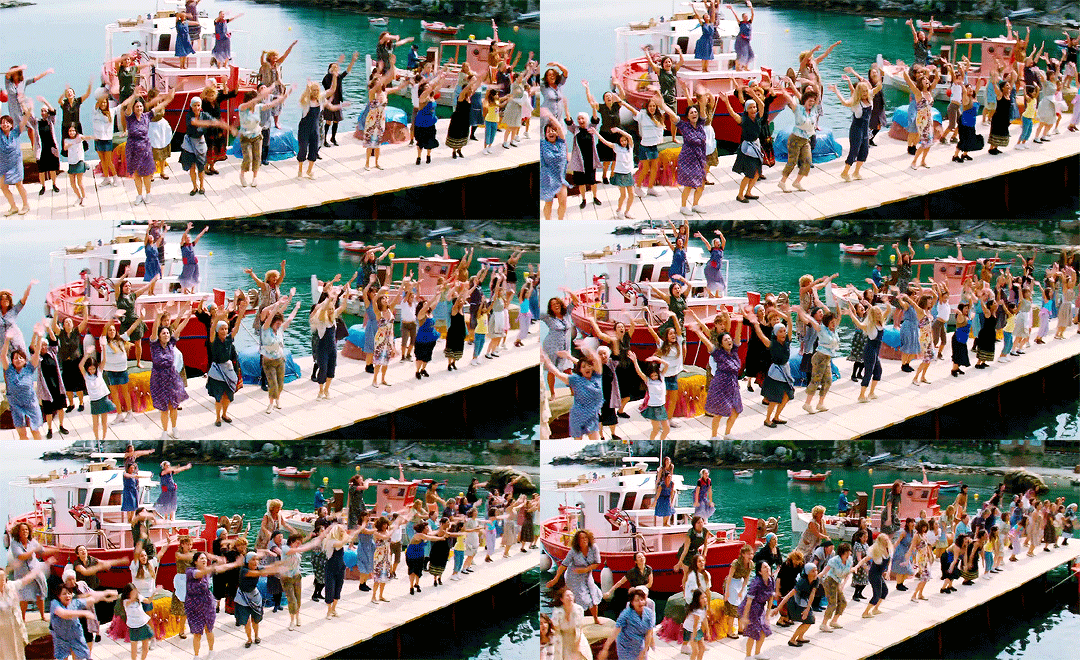
      But I think we learn all we need to know about how this movie sees itself and the institution of musicals in the “Dancing Queen” number. This song has Tanya and Rosie bolstering up Donna after the embarrassment of her baby-daddies seeing her in overalls. Donna begins the scene approaching much-needed self-reflection, but her gal pals are like “no, can’t have any of that,” and tell her that she actually needs is a healthy dose of regression. They tell her to drop her adulthood responsibilities and go back to a time when sleeping with every man was fun.

        The sequence has Donna, Rosie, and Tanya prancing out the inn and across town in their dress-up with other members of the community joining the parade. The culminating moment here comes when all the band members jump in the ocean. This number represents everything the movie thinks it’s selling the audience. Screen Queen writer Marina Vuotto says of the film: 

“That is precisely the feeling Mamma Mia! wants to elicit in its audience: it’s a temporary relief, it has to be pure escapist fun, it has to be over-the-top, because it has to be the opposite of real life. And yet, because of its deep understanding of its audience, it tackles precisely the issues they’re seeking escape from. In the world of Mamma Mia!, these issues are going to be resolved through ABBA songs, glitter and flashy costumes, and although these are not enough to solve real-life problems, they are enough to forget them for a while.”

    I get it. Who hasn’t wanted to drop their chores so they could jump in the ocean? But we know that this isn’t how life works. You have your fun, you dry off, and then realize your check’s bounced and the dishes are only piling up. 

   Good musicals don’t make false promises like this. They offer their audiences more than just sugar crashes and hangovers. When you look at musicals that really work, you’ll see fireworks, yes, but more than that, you see profundity, transcendence, truth. At the very least you see the aspiration for it. You certainly don’t see fifty-year-olds flashing in the mirror and calling it growth.

    In Mamma Mia, singing is not the divining instrument to higher understanding; rather, it's the narcotic these characters intake to evade any aspect of reality that is not sequined and bedazzled. ABBA is the lotus flower these islanders consume to preserve their perpetual obliviousness. This isn’t release. This isn’t illumination. This isn’t catharsis. This is just alcohol. A distraction. A delusion. Regression. Exactly what the cynics have always said. Musicals are a joke, and the egg’s on our face.


“It’s Just a Musical”

    I know what you're thinking, "Gosh, Professor, is it really such a big deal if people just want to watch to watch a bunch of fifty-year-old women jump into the water on a Saturday night?" To that, I say, "no." I do understand where this film's fanbase comes from. And I don't think it marks some character deficit if this movie somehow brings you comfort.

    Meryl Streep, objectively the best thing about this movie, had her own connection to the source material, having watched the stage show the month after the attack on the World Trade Center. The experience brought a great deal of comfort to her and her family, and she personally wrote to the producers of the show thanking them for inviting a little more happiness into her life following a time of great social upheaval. 

        If your experience with Mamma Mia is something like Meryl Streep’s, I’m not here to cast stones. Sometimes we’re just hungry for straight cheese, and Mamma Mia is certainly that. It’s a similar type of appetite that has me returning to the hot mess that is the Clash of the Titans remake. Individual taste is a funny thing, and I don’t think it speaks to some character deficit if this is your jam.

        That said, I’m also not satisfied to say that just because someone has an emotional attachment to something that means they can’t question it or that they shouldn’t aspire for more substance. The narrative of “it’s just a musical, don’t overthink it,” is especially troubling to me. This perspective is not only dismissive of the capacity musicals have, it encourages a kind of complacent laziness. 

Silver Linings Playbook (2012)
Entertainment motivated purely by blameless indulgence is entertainment wasted. Good media has the potential to do more than just spew glitter over the pit that is adult living. Good media can give you the strength to lift yourself out of that hole. This is true of not just good musicals, but any film that takes its responsibility as a vessel of truth seriously.

  If you don’t know what I’m talking about, I’m just going to leave one last plug for my Moulin Rouge! piece here. 

          --The Professor

Comments

  1. Professor, you wrote: "Meryl Streep [is] objectively the best thing about this movie..." Sadly, that alone is why I'm not thrilled about this movie. I can't say why, but I've never connected with her as an actress and, when she is the "best thing" about a flick, that doesn't offer much redemption for a film, in my view.

    Thanks for this review. I enjoyed the survey of the landscape of other more worthy musicals!

    ReplyDelete

Post a Comment

Popular posts from this blog

Toy Story 4: Pixar's Tribute to Regression

          It was about this time last year that I came across the one person who actually hated Toy Story 3 .          I was reading Jason Sperb’s book “Flickers of Film: Nostalgia in the Age of Digital Cinema” as part of my research for my essay on Who Framed Roger Rabbit and Pokemon: Detective Pikachu . It was in one of his chapters on the Pixar phenomenon that he shared his observation from the ending of Toy Story 3 , essentially casting the film as this nostalgia mousetrap for adults: “ If Andy lets go of his childhood nostalgia and moves on, then Toy Story fans don’t really have to , as the narrative recognition in the potential value in such an act is sufficient. Actually moving on becomes indefinitely deferred in an endless cycle of consumption (rewatching the movies, purchasing new versions of the movie, purchasing more and more Toy Story-related merchandise, rewatching them yet again with the next generat...

(Almost) A Love Letter to the "Percy Jackson" Movies

    Maybe it's just living through a pandemic-stained world rife where each election feels like a last-ditch effort to rescue liberty from the oblivion, but I'm sometimes nostalgic for the days when the most traumatic thing in my life was a poor adaptation of a favorite book.      My generation will remember the film adaptation of the popular YA fantasy book Percy Jackson and the Olympians: The Lightning Thief by Rick Riordan with something like embarrassment, if not outright lividity. The book follows a young teen, Percy Jackson, who discovers that the gods of ancient Greece not only exist, but also sire modern day heroes. As a child of one of these gods, Percy is continually drawn into their Olympian-sized conflicts wherein he gets to prove himself every bit as much a hero as Hercules.       Each installment of the five-book series reads like a theme-park ride through Greek mythology as the teens travel across the country battling ancient m...

REVIEW: Disclosure Day

     Maybe it was self-control that compelled Spielberg to build his whole movie around aliens but give the aliens themselves as little screentime as possible. (Or, for all I know, he did it on a dare.)  But this is only one of the risks taken by his latest film.       This first encounter picture is distanced from something like Independence Day and more toward something like 2001: A Space Odyssey --and it's even closer to something like Arrival . The film sees a cyber-security worker, Daniel Kilner (Josh O'Connor) who defects with the intent to reveal what he knows to the world: the government has had repeated, secret encounters with extraterrestrial life. He has a team of underground sympathizers, lead by Hugo Wakefield (Colmon Domingo), but he also has agent Noah Scanlon (Colin Firth) out to stop the truth at any cost. Kilner's only chance getting the truth out there is in joining up with Margaret Fairchild (Emily Blunt), a newscast personali...

Some Much Needed Love for Megamind

    Following this year's Oscars ceremony, filmmakers Phil Lord and Chris Miller, directors of The Lego Movie , penned an op-ed for Variety bemoaning the stigma around animated films. They report taking issue with Naomi Scott, one of the presenters for best animated film, saying that animated films are some of the most formative experiences a kid has, and that kids tend to watch these films over and over, further noting "I think some of the parents out there know exactly what I'm talking about." Lord and Miller seemed to take this as implying that adults can't appreciate animated films, saying "Surely no one set out to diminish animated films, but it’s high time we set out to elevate them."                    I didn't personally find Scott's observation that kids make their parents watch the same animated films over and over again innately demeaning--certainly not any more than Schumer joking that her toddler made he...

REVIEW: Song Sung Blue

     I came into Craig Brewer's Song Sung Blue with little context for the real-life couple at the center of this movie, for Neil Diamond, or for the world of celebrity  impersonators  interpreters. There are no doubt subterranean connotations to the specific songs that they chose to sing at certain moments in the narrative that are lost on me. I have no doubt, though, that the intended audience will find this movie before long.  But the film was still viable enough that even a relative neophyte like me could still find himself humming along to this musical drama.     The film documents the real-life couple of Mike and Claire Sardina, celebrity impersonators who fall in love, marry, and form a tribute band for legendary singer, Neil Diamond. We track their relationship from its beginning through their career aspirations and the crossroads in their marriage, including a violent accident that changes their family forever.     Again, I don...

REVIEW: HOPPERS

     In the 1950s under the threat of nuclear warfare, Hollywood premiered such exercises as The Day the Earth Stood Still or War of the Worlds where an alien power would pass judgment on humankind, holding its fate in its hands. Here in the 2020s under the shadow of such threats as climate change, Hollywood sends to be our judge ... beavers.     Let me back up ...      Daniel Chong's new film from Pixar Animation, Hoppers , sees  Mabel (Piper Curda), a college student whose self-appointed mission is to preserve the glade where she used to find sanctuary with her now deceased grandmother. Her biggest opponent is hometown boy and beloved mayor, Jerry (Jon Hamm), who has designs to plow over the glade in order to open his new freeway--estimated to save travelers four whole minutes of commuting.       Mabel gets her golden opportunity when she uncovers secret technology pioneered by her professor which allows a human to rem...

REVIEW: Soul

Pixar's latest film, Soul , dropped on Disney+ Christmas day, another regrettable casualty of the virus. This time around, we follow a hopeful musician bursting with enthusiasm. Music is an oddly appropriate metaphor for the film: both certainly touch the outer rim of mankind's emotional faculty, but good luck summarizing the experience to your friends. Joe Gardner is a music teacher at a public school whose enthusiasm for music is spilling out of the walls of his classroom. Opportunity strikes Joe the same day that misfortune does, and a fatal accident lands him in a celestial plane of existence known as "The Great Before," where souls are developed and finessed before being sent to earth to experience human existence. Joe is saddled with mentoring 22, a soul sapling who has settled in The Great Before for several hundred years and has no intention of ever giving mortality a chance. But in 22, Joe sees a chance to return back to earth and fulfill his purpose if he ca...

The Notebook Has No Excuses

     The thing about film is … the more you think about it, the less sense it makes. Film tells us, even in a society obsessed with wealth and gain, “Remember, George, no man is a failure who has friends.” Film warns us that the most unnatural evil lies in wait at the Overlook Hotel and peeks out when all the guests leave for the winter–and that the heart of it resides in room 237–knowing we'll trip over ourselves wanting to open that door. Film is what makes us believe that the vessel for the deepest human emotion could be contained in a cartoon clownfish taking his unhatched cartoon son and holding him in his cartoon fin and telling him he will never let anything happen to him.  Nights of Cabiria (1957) Even when it tries to plant its feet aggressively in realism, film winds up being an inherently emotional realm. We feel safer to view and express all manners of passions or desires here in the space where the rules of propriety just don’t matter anymore. So a fa...

Charade: The Shortest Distance Between Two Words

It can feel hackneyed, and even a little lazy, to echo that oft-repeated sentiment that “they really just don’t make ‘em like they used to.”  That kind of nostalgic wallowing has us forget that, yeah, even the old masters sometimes produced real stinkers. And it’s also not fair to the many storytellers today who, working against ever turbulent conditions, still manage to create something deeply profound and worthy of the deepest reverences …       But there are absolutely times where it’s really easy to believe this anyways.      Let me explain by describing my recent experience watching Argylle for the first time earlier this year. The film was designed as a spin-off from the “Kingsmen” franchise and saw poor Bryce Dallas Howard playing Elly, a reclusive spy novelist, whose life is turned upside down when a host of malicious agents converge on her demanding that she write her final book because the events in her novels have predicted real w...

Reveling in the Mixed Messages of Miss Congeniality

In book ten of Metamorphoses, Greek poet Ovid tells the tale of Pygmalion, a talented sculptor living in the height of ancient Greek society.      According to the story, Pygmalion’s sculpting prowess was so impeccable that one of his pieces, a marble woman he christened Galatea, was said to be the lovelier than any woman of flesh and blood. Pygmalion was so taken by his creation that he brought her exotic gifts, kissed her marble cheeks, even prepared a luxurious bed for her. Pygmalion so pined to be loved by Galatea that he prayed to the goddess Aphrodite to allow Galatea to reciprocate his love and affection. Aphrodite was apparently in a good mood that day, so she granted Pygmalion’s wish, giving life to Galatea, whom he then wed. The story of Pygmalion is in essence the story of a man who creates his own idealized woman out of whole cloth (or more appropriately, marble), endowing her with all the traits that he finds appealing or alluring. The story also provides a m...