REVIEW - The Little Mermaid


    There's been a mermaid on the horizon ever since it became clear sometime in the last decade that Disney did intend to give all of their signature titles the live-action treatment--we've had a long time to prepare for this. (For reference, this July will mark four years since Halle Bailey's casting as Ariel made headlines.) 

    Arguing whether this or any of the live-action remakes "live up" to their animated predecessor is always going to be a losing battle. Even ignoring the nostalgic element, it's impossible for them to earn the same degree of admiration because the terrain in which these animated films rose to legend has long eroded. This is especially the case for The Little Mermaid. Where this remake is riding off a years long commercial high for the Walt Disney Company, the Disney that made The Little Mermaid in 1989 was twenty years past its cultural goodwill. Putting out an animated fairy-tale musical was not a sure thing, yet its success sent ripples through the film world that are at once impossible to miss yet consistently overlooked. 

    What, then, does this live-action rendition bring to the mythology in this age?

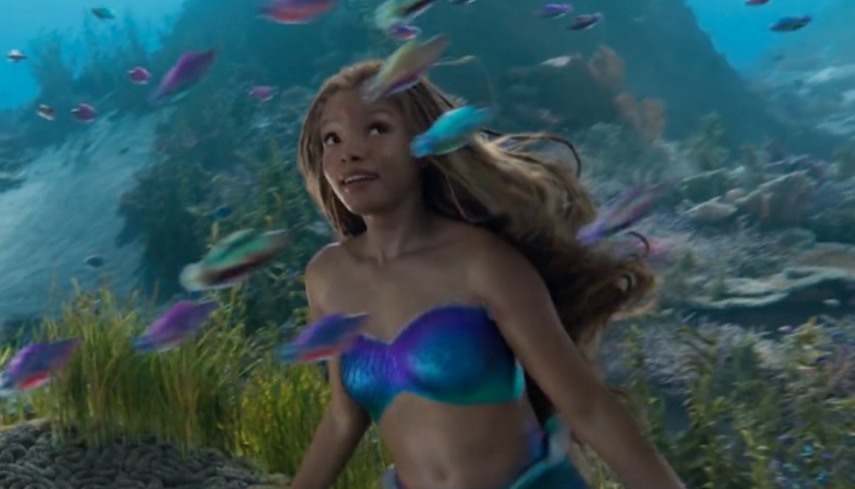
    The film finds some success in the visual department. Even with a landscape as lush as the ocean reef, the photorealistic visuals can't quite match the majestic tapestry of hand-drawn animation, but (even as I was questioning the honesty of some of the sea life flailing their fins the way that they do) I won't deny that the choreography of something like the "Under the Sea" number made me glad I invested in a 3d ticket. 

    Roughly half of the spoken lines from this film are carried from the animated film. In a way this adaptation almost can't help but default to the manufacture settings set by 1989 film. The animated text is already close to perfection, but as a consequence of its fidelity, any narrative addition or modification is going to be instantly noticed, and not all of these changes ultimately strengthen the text. 

    There is a case to be made for Ariel herself taking out the villain in her own story, but their approach with this climax was just to have Ariel and Eric swap places, and the result doesn't feel entirely organic or even satisfying. It checks off a box without really granting Ariel a victory that is suited for her specifically. If anything, it betrays a sort of lack of confidence in what Ariel as a character brought to her story. 

    There's little added here that hadn't already been inferred by longtime lovers of the animated film, but that's not necessarily a bad thing. Maybe it's not revelatory to propose that Eric is on the sea so much because he's got some wanderlust, and we all kinda guessed that the humans killed Ariel's mother. Just so, there is something validating about seeing the magic carry across an expanded runtime. If anything, it shows good judgment on this creative team that most of these changes feel like they were already there, like canonized subtext.

    Much of what can be considered truly new comes from the fresh performances of this cast, in which there isn't really a weak link. Halle Bailey walks and swims with equal grace, a wide-eyed beholder of the fantastical landscape she is privy to, save for the moments when she herself becomes yet another ornament in the film's otherworldly storybook. Her energy is matched by the earnest and endearing Jonah Hauer-King as the courageous Prince Eric. And while we're waiting for Disney animation to give Disney villains another try, audiences have found a holdover in Melissa McCarthy, who graciously chooses to play Ursula as a villain with a sense of humor and not a comical villain. 

    Thus far, I've talked about "source material" in relation to the 1989 animated film directed by Ron Clements and John Musker, but of course the story goes way beyond that. Disney inherited this tale from the imaginative pen of Hans Christian Andersen. This connection is referenced within the text of the remake with an overtness that is maybe unprecedented in this train of remakes (you'll see). But it's not just the tip of the hat that nearly brought tears to this critic's eyes. It was the depth afforded to understanding why the story of a mermaid who pined to walk on the shoreline would inspire such elemental feelings across the centuries, and how this emotional pulse has carried through the legendary animated film. There is, after all, a special kind of heartbreak reserved for anyone who reaches for the light even as the world tells them to keep their head underwater. But there is also a special kind of reverie, even triumph, for those who dare to walk on their own two feet just the same. 

    Thanks for reminding us. 

        --The Professor


Comments

  1. Hum? Not convinced that it is as good as the original. I'm intrigued by the suggestion that a 2:15 long live-action version of this classic did not lose momentum 2/3rds of the way through. But I struggle to imagine an Ariel as pleasing as the 1989 depiction, though very much thrilled by the thought of Ursula being depicted by Melissa McCarthy! Pros and cons here, but probably enough curiosity piqued to get me to watch the remake...though I remain fearful that it will be a disappointment in comparison to the original. (Your review didn't leave me convinced that it wont be!)

    ReplyDelete

Post a Comment

Popular posts from this blog

REVIEW: You, Me & Tuscany

    I've learned not to be ungrateful for movies like  You, Me & Tuscany . It's the kind of picture that can be easily written off as predictable or derivative.      And Kat Cairo's film definitely rides on some genre shorthand. Halle Bailey's Anna has very similar flaws to most rom-com heroines as this untethered 20-something trying to figure out how to stretch a check. And the story itself lands about where every one of these movies do. (Though, remind me, how does every Tom Cruise movie end?)      After the screening concluded, one of the ladies sitting behind me even said something much like, "Yeah, that was a lot like While You Were Sleeping ." But she didn't sound smug in her assessment. Her pronouncement was more encoded with the excitement that comes with discovery--the realization that she had found something like a worthy successor. And as a fan of Sandra Bullock's second-best rom-com, I was inclined to agree with this la...

All The Ways Sunset Boulevard Has Aged Gracefully

So, stop me if you’ve heard this before: Hollywood has a dark side.          Particularly in the wake of something like #MeToo or the double strikes of 2023, you can really get a sense for just how famishing, even degrading, it can be trying to make a living in Hollywood. But of course, it all goes back much further than those. One of my very first essays for this blog was a catalogue of all the ways Hollywood ravaged Judy Garland , to point to another example. Yet for all its mess, we cannot take our eyes off of Hollywood, or the people who build it.  Stardom in particular becomes a popular focal point—what is it really like being on the other side of all that spotlighting? And Hollywood has naturally supplied the market with all sorts of imaginings for this as well. Thus, each generation gets its own version of A Star is Born. John Wayne and Maureen O'Hara in The Quiet Man (1952)      Ty Burr wrote in his landmark work,...

Reveling in the Mixed Messages of Miss Congeniality

In book ten of Metamorphoses, Greek poet Ovid tells the tale of Pygmalion, a talented sculptor living in the height of ancient Greek society.      According to the story, Pygmalion’s sculpting prowess was so impeccable that one of his pieces, a marble woman he christened Galatea, was said to be the lovelier than any woman of flesh and blood. Pygmalion was so taken by his creation that he brought her exotic gifts, kissed her marble cheeks, even prepared a luxurious bed for her. Pygmalion so pined to be loved by Galatea that he prayed to the goddess Aphrodite to allow Galatea to reciprocate his love and affection. Aphrodite was apparently in a good mood that day, so she granted Pygmalion’s wish, giving life to Galatea, whom he then wed. The story of Pygmalion is in essence the story of a man who creates his own idealized woman out of whole cloth (or more appropriately, marble), endowing her with all the traits that he finds appealing or alluring. The story also provides a m...

Butch Cassidy and the Sundance Kid: Westerns Riding off into the Sunset

In both my Les Miserables and Moulin Rouge! pieces, I made some comment about the musical as the genre that receives the least love in the modern era. I stand by that, but I acknowledge there is one other genre for which you could potentially make a similar case. I am referring of course to the western film. See, musicals at least have Disney keeping them on life alert, and maybe one day we’ll get the  Wicked  movie Universal has been promising us for ten years [FUTURE EDIT: All good things, folks ]. But westerns don’t really have a place in the modern film world. Occasionally we’ll get films like  No Country for Old Men,  which use similar aesthetics and themes, but they are heavily modified from the gun-blazing-horseback-racing-wide-open-desert w esterns  of old.  Those died, oddly enough, around the same time musicals fell out of fashion.              Professors Susan Kord and Elizabeth Krim...

The Belle Complex

As Disney fandom increasingly moves toward the mainstream, the discussions and questions that travel around the community become increasingly nuanced and diverse. Is the true color of Aurora's dress blue or pink? Is it more fun to sit in the back or the front on Big Thunder Mountain? Is the company's continued emphasis on producing content for Disney+ negatively impacting not only their output but the landscape for theatrical release as a whole?  However, on two things, the fandom is eternally united. First, Gargoyles  was a masterpiece in television storytelling and should have experienced a much longer run than it did. Second, Belle's prom dress in the 2017 remake was just abominable.      While overwhelmingly successful at the box office, the 2017 adaptation is also a bruise for many in the Disney community. Even right out the gate, the film came under fire for a myriad of factors: the auto-tuned soundtrack, Ewan McGregor's flimsy accent, the distracting plot...

REVIEW: ELIO

    Here's a fact: the term "flying saucer" predates the term "UFO." The United States Air Force found the former description too limiting to describe the variety of potential aerial phenomena that might arise when discussing the possibility of life beyond earth.      There may have to be a similar expansion of vocabulary within the alien lexicon with Pixar's latest film, Elio , turning the idea of an alien abduction into every kid's dream come true.      The titular Elio is a displaced kid who recently moved in with his aunt after his parents died. She doesn't seem to understand him any better than his peers do. He can't imagine a place on planet earth where he feels he fits in. What's a kid to do except send a distress cry out into the great, big void of outer space?      But m iracle of miracles: his cries into the universe are heard, and a band of benevolent aliens adopt him into their "communiverse" as the honorary ambassador o...

The Case for Pre-Ragnarök Thor

  The Marvel Cinematic Universe has become such a fixture of pop culture that it’s difficult to imagine that the whole ordeal was actually a massive crapshoot.                     The biggest conceit of the MCU has been its ability to straddle a thousand different heroes—each with their own stories, casts, and universes—into one cohesive whole. It’s a balancing act like nothing that’s ever been attempted before in the hundred years of filmmaking. A lot of the brand’s success can be attributed to the way that each individual story adheres to the rules of its own specific universe. The Captain America movies serve a different purpose than the Spiderman movies, and all the movies in the Captain America trilogy have to feel like they belong together.      There are, of course, questions posed by this model. In a network of films that all exist to set up other ...

"When Did Disney Get So Woke?!" pt. 1 The Disney of Your Childhood

  So, I’m going to put out a somewhat controversial idea here today: The Walt Disney Company has had a tremendous amount of influence in the pop culture landscape, both in recent times and across film history. Further controversy: a lot of people really resent Disney for this.  I’ve spent a greater part of this blog’s lifetime tracking this kind of thing. I have only a dozen or so pieces deconstructing the mechanics of these arguments and exposing how baseless these claims tend to be. This sort of thing is never that far from my mind. But my general thoughts on the stigmatization of the Disney fandom have taken a very specific turn in recent times against recent headlines.       The Walt Disney Company has had some rather embarrassing box office flops in the last two or three years, and a lot of voices have been eager to link Disney’s recent financial woes to certain choices. Specifically, this idea that Disney has all the sudden “gone woke.”  Now,...

REVIEW: The Running Man

      A lot of people have wanted to discuss Edgar Wright's new The Running Man outing as "the remake" of the 1987 film (with Arnold Schwarzenegger playing a very different Ben Richards). As for me, I find it more natural to think of it as "another adaptation of ..."      Even so, my mind was also on action blockbusters of the 1980s watching this movie today. But my thoughts didn't linger so much on the Paul Michael Glaser film specifically so much as the general action scene of the day. The era of Bruce Willis and Kurt Russell and the he-men they brought to life. These machine-gun wielding, foul-mouthed anarchists who wanted to tear down the establishment fed a real need for men with a lot of directionless anger.       This was, as it would turn out, the same era in which Stephen King first published The Running Man , telling the story of a down-on-his luck man who tries to rescue his wife and daughter from poverty by winning a telev...

Notoriously Human: Alicia and the "Strongfemalecharacter"

    The further I dive into classical Hollywood, the more taken I am by all its fascinating contradictions.       This wasn't, I'll acknowledge, a period in American history which we think of as being kind toward women or recognizing their autonomy.  The Mark of Zorro (1920)          I think the collective point of reference most people have for women in old movies is the sort of hero's trophy who waits around for the guy to swoop in and carry her out of the mess she has made for herself, and that image has some basis in how Hollywood itself behaved.  But film history covers a lot more than just that one type.                 The Hays Code prohibited illicit sexual material on film, among other things, and was in effect until the early 1960s. Because sexual content was greatly monitored and regulated, female characters weren’t really objectified--at lea...